Why a Safe School Environment Matters So Much for Children
“As long as the academics are strong, safety takes care of itself.”
Why this matters
Safety is the floor learning stands on
Parents in the UAE choose schools on curriculum, campus, and reputation. Safety usually gets a quick nod and a tick on a checklist. That is a mistake. A child who does not feel safe, physically, medically, or emotionally, will not absorb what the teacher is saying, no matter how good the lesson plan is.
The Knowledge and Human Development Authority (KHDA) and the Ministry of Education both weight safeguarding heavily in inspections for a reason: it is the base layer of every good school. Below are five myths that keep coming up in parent conversations, and what the reality actually looks like from primary through the middle school years and beyond.
Myth 1: A sick child at school is not really a big deal
Every parent has felt the pressure. A child wakes up with a sore throat on a test day, and sending them in feels easier than rearranging the week. The thinking goes: one sniffly kid cannot do much harm.
Reality: one sniffly kid is exactly how a whole year group ends up on antibiotics two weeks later. Classrooms in the UAE are air-conditioned, closed environments where thirty children share desks, door handles, and water fountains. A single virus travels through a class in days. According to the World Health Organization respiratory viruses spread most efficiently in enclosed indoor settings, which describes almost every UAE school between October and April.
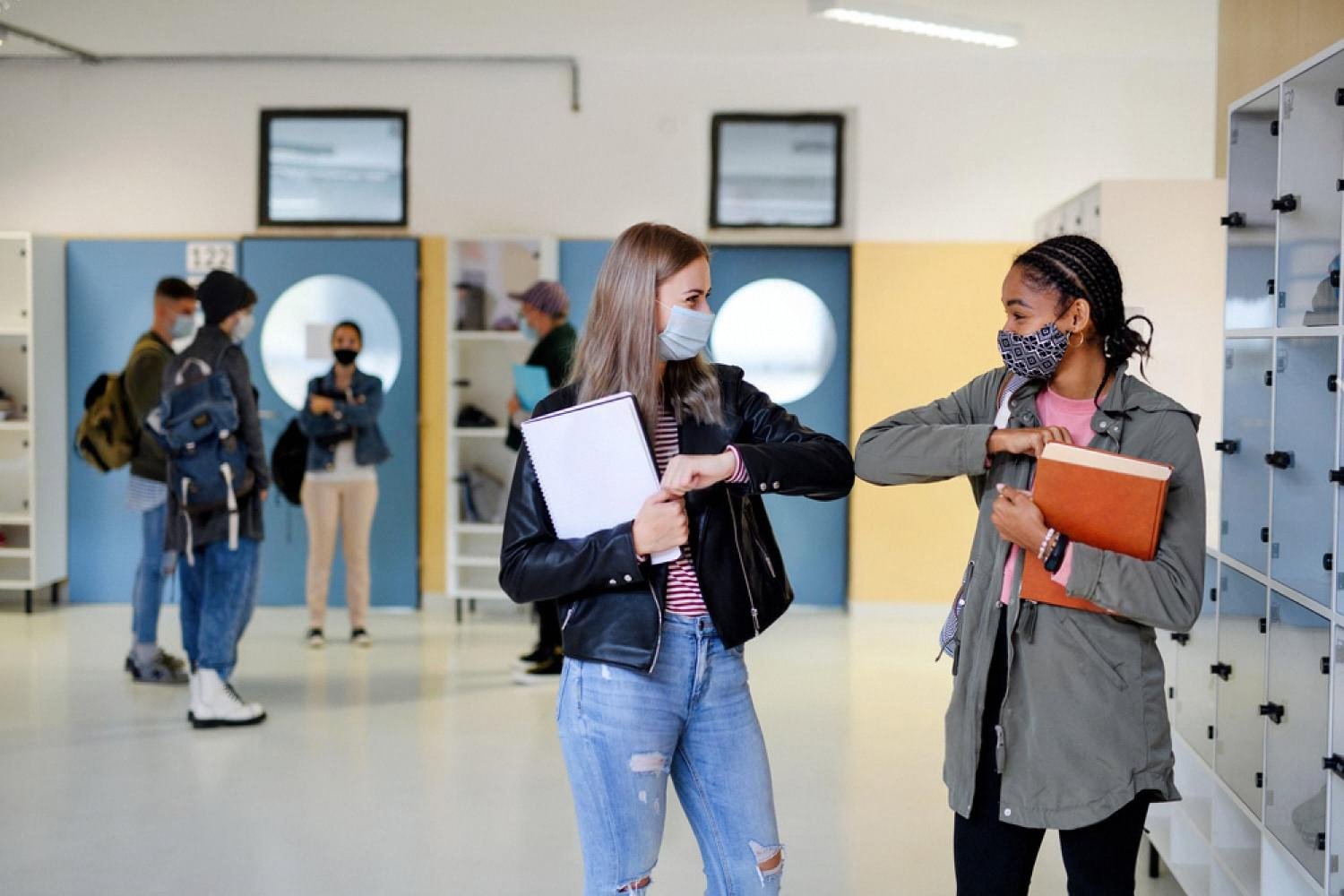
A safe school has a clear sick-child policy, a nurse or clinic on site, and a culture where staying home is respected, not penalised. Parents notice the difference within a term: fewer mass absences, fewer disrupted lessons, and calmer teachers who are not covering for sick colleagues.
Myth 2
“Emergency drills scare the children more than they help”
Some parents worry that fire drills, evacuation routines, and shelter procedures introduce fear into a place that should feel light. The instinct is protective, but it points at the wrong risk.
Reality: children get frightened when adults look uncertain. A well-drilled school does the opposite. Teachers know their route, children know which line to join, and the whole thing is treated as an ordinary part of the calendar. With regional tensions and global news reaching every family screen, the ability to move 600 children out of a building calmly, without panic, is not paranoia. It is basic care.
- Clear evacuation maps posted in every classroom, in language children can read.
- Shelter or safe-room provision where the school design allows it.
- Regular, low-drama drills so movement becomes muscle memory, not a scare.
- Staff training that covers first aid, fire, and lockdown, refreshed yearly.
Myth 3: Emotional safety is a “soft” issue, academics come first
This one is stubborn. The argument goes that a strict, high-pressure environment builds resilience, and that focusing on feelings is a distraction from real learning.
Reality: the brain does not learn well under threat. When a child is bracing for a teacher’s temper, or worried about being embarrassed in front of the class, working memory shrinks and information does not stick. Research summarised by the Harvard Center on the Developing Child shows that sustained stress in childhood measurably impairs cognitive function and executive skills.

A child who feels emotionally safe, whose teacher speaks calmly, corrects without shaming, and notices when something is off, will take on harder work willingly. Emotional safety is not the enemy of high standards. It is what makes high standards achievable.
Myth 4: Bullying is just kids being kids, they sort it out themselves
A lot of adults grew up hearing this. It sounds pragmatic. It is also wrong.
Reality: bullying that is left alone does not resolve, it consolidates. The child on the receiving end learns that adults will not step in, and the child doing the bullying learns that the behaviour has no cost. Both lessons are damaging, and both follow children into secondary school and adulthood.
- Teachers see it first. Playground exclusion, sarcastic comments, group chats that suddenly go quiet when someone walks in. A trained eye catches these.
- The school has a named process. Reporting is easy, confidential, and does not require the child to make a formal complaint before anything happens.
- Follow-up is real. Not a single meeting and a promise, but a check-in weeks later to see whether the situation has actually changed.
- Digital behaviour counts. What happens on group chats after school is part of the school’s world in the UAE, where students often share transport and building compounds.
A school that says “we have zero tolerance” on the website but shrugs at parent emails is not a safe school. Ask specifically how the last incident was handled. The answer tells you everything.
Myth 5: A child who dislikes school will “grow out of it”
Reality: sometimes yes, often no. When a child dreads school every morning, and the reason is the environment rather than a passing phase, the pattern hardens. Sleep suffers, appetite shifts, small stomach aches on Sunday nights become a regular event. The child stops trying because the effort feels pointless. Eventually the resentment turns outward, toward classmates, siblings, and the parents who keep insisting.
The children who stop learning are almost never the ones who cannot. They are the ones who no longer feel safe enough to try.
If a child is telling you, in words or in behaviour, that school feels bad, that is data. It is worth a serious conversation with the class teacher, and if the answer is dismissive, worth looking at what other schools in your emirate offer.
The costly myth
The most expensive belief on this list
Assuming safety is standard. Every UAE school has policies on paper. Not every school lives them. The gap between the parent handbook and the actual daily culture is where children get hurt, quietly, over years.
Visit the campus. Talk to current parents. Ask about the last bullying incident, the last evacuation drill, the last time a teacher was retrained. Vague answers are answers.
What a genuinely safe UAE school looks like
- A visible medical presence, with clear protocols for sick children and communication with parents.
- Emergency procedures that are practised, not just printed. Staff can describe them from memory.
- Teachers who correct firmly but never shout, and leaders who back them up when they choose kindness.
- A named anti-bullying process that produces follow-up, not just meetings.
- Space for children to talk to an adult who is not their class teacher, a counsellor, a nurse, or a well-briefed head of year.
- Parent communication that arrives before rumours do, especially when something has gone wrong.
Curriculum, facilities, and results all matter. But they only compound when the child underneath them feels safe enough to show up as themselves. That is the whole game.
Frequently asked questions
How can I tell if my child feels emotionally safe at school?
Watch the transitions. A child who feels safe talks about school without prompting, mentions specific classmates and teachers by name, and does not visibly tense up on Sunday evenings. Signs of the opposite include stomach aches without a medical cause, reluctance to describe the day, sudden drops in appetite, and disturbed sleep.
If you see two or three of these patterns lasting more than a couple of weeks, request a meeting with the class teacher and ask direct questions about peer dynamics and classroom tone.
What should I ask a UAE school about safety before enrolling?
Ask five concrete things: how sick children are handled and where they wait, when the last full evacuation drill happened, what the written anti-bullying process actually produces (not just what it says), how teachers are trained on de-escalation, and how the school communicated with parents during the last incident of any kind.
Specific answers with names and dates are a good sign. Generic reassurance is not.
Is bullying really a problem in well-regarded UAE schools?
Yes. Reputation and fees are not immunity. Any environment where children spend six hours a day together will produce social friction, and some of it will cross into bullying, including online. What separates a safe school from an unsafe one is not the absence of incidents, it is how quickly and seriously the adults respond.
Should schools in the UAE have shelter or lockdown procedures?
Any responsible school anywhere in the world plans for emergencies, from fire to medical to security. In the UAE, civil defence regulations already require fire evacuation plans and drills. Beyond that baseline, schools should be able to describe what happens if the building has to be cleared quickly for any reason, and how children with mobility needs are supported during that process.
My child is quiet and does not complain. Does that mean everything is fine?
Not necessarily. Quiet children often absorb stress internally rather than reporting it. Look at behaviour at home: is your child more withdrawn, more irritable, less interested in things they used to enjoy? Those changes matter even when the child says school is “fine.”
Building a habit of low-pressure conversation, asking about one specific thing rather than the whole day, tends to open the door more reliably than direct questioning.
How do teachers contribute to emotional safety day to day?
Through tone more than technique. A calm teacher who corrects a mistake without sarcasm, notices the child sitting alone at break, and does not use humiliation as a management tool is doing the core work. Teacher training and manageable class sizes make this consistent behaviour possible. When teachers are burnt out or unsupported, emotional safety is usually the first thing to slip.
What should I do if my child says they do not want to go to school?
Take it seriously, but calmly. Ask open questions across several days rather than one interrogation. Try to find out whether the issue is a specific person, a specific subject, a physical worry, or a broader mood. Share what you learn with the class teacher and ask for a plan with a review date.
If the school’s response is defensive or vague, and the pattern continues, it may be time to look at other options in your emirate.